^Wake ^Rise ^Operate ^Fruitfully ^Summer ~conscious~ ~operator~ ~operation~ ~fruit~ ~awakening~
Figure
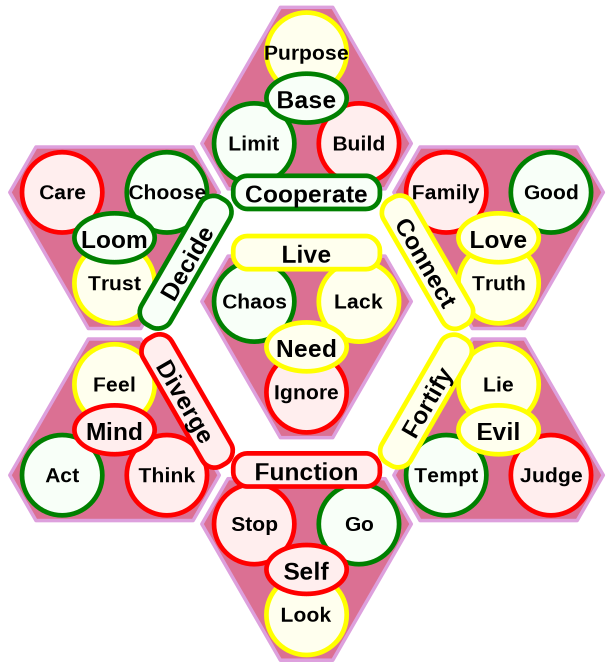
Annotate
-
^Stop and ^Think.
- A ~self~ so that we may ^Function.
- A ~mind~ or ~care~ so that we may ^Diverge or ^Live.
- A ~mess~ or ~MESH~ so that we may ^Restore.
-
^Choose within ~limit~.
- A ~base~ or ~weave~ so that we may ^Decide, ^Operate or ^Cooperate.
-
Have ~trust~ or ~sorrow~ within ~truth~ or ~lie~.
- ^Decide our ~connection~ to ~truth~.
- ^Show ~sorrow~ to ^Express our ~need~.
-
^Truth within all and all may ^Come by ~love~
yet mostly ~unknown~.
- ^Feel the ~love~, ~evil~ or ~need~ so that we may ^Connect, ^Fortify or ^Motivate.
- ^Consider the ^Big ~picture~ yet our ~lack~ may ^Deceive us.
Subject
^Operate is a mode of ^Mind to ^Describe ~variety~ of ~action~. We ^Exercise our ~mind~ in ~repeat~ in ~variety~ of sizes from ~small~ to ~large~. ^When we ^Work with our ~mind~, we ^Want to ^Explore it in ~tune~ to its ~context~.
We may ^Want to ^Identify or ^Apply a (^Mind-)^Like ~pattern~. ^Exercise the ^FAT ~model~ of the ~mind~ in ~accord~ ^Regularly to ^Help ourselves and to ^Share our ~progress~ with others.
Target
Anytime we ^Start to ^Work with our ~mind~ or that of others, ^Consider its ^Three ~parts~ in ~context~.
For a ~problem~ or ~solution~ of any size in any ~domain~ that we might ^Hold.
To ^Give a ~picture~ of the ~wrestle~ that we ^Face, we may ^Consider, ^Estimate and ^Mind the size of a ~problem~ and ~solution~. ^How ^Big is the ~problem~? ^How ^Big ^Respectively should the ~solution~ ^Be? Which ^Operator might ^Be the ~best~ to ^Apply in ~relation~ to a ~problem~?
In a ^Particular ~domain~, we ^Solve the ^Smallest ~problem~ in the ~self~. For ^Bigger problems in that ~space~ we ^Add ^More operators. For a ~worry~ ^Bigger than we can ^Heal in our ^Own ~self~, ^Try to ^Add in ~order~: the ~mind~, ~loom~, ~base~, ~love~, ~evil~ and ~need~ ^Last.
Our ~need~ may ^Target the ^Largest ~problem~ (for ~example~, ~emotional-failure~), yet it is the ~smallest~ ~as~ a ~solution~. From ~smallest~ to ~largest~, we may ^Seek a ~solution~ in our ~need~, ~self~, ~mind~, ~loom~, ~base~, ~love~ and ~evil~ ^Last. ^Evil may ^Grant the ^Largest ~solution~ yet it might ^Never ^Adequately ^Tackle the ^Largest ~problem~ in a ~domain~.
We may ^Hold or ^Consider some operators for ^General ~application~. We may ^Apply our ~need~ ^Generally to ^Help us to ^Grow ~as~ a ~family~. Every ~need~ we ^Express may ^Need us to ^Make ~peace~ and ~quiet~ from our ^Own negative ~emotion~ for sake of ~one-another~. ^Trust, ^Choose and ^Care are modes that ^Loom ^Together yet each is an ~operator~ in its ^Own ~right~ which we may ^Apply ^Generally. ^Needless to ^Say, we may ^Apply the ^Operate ^Concept ^Generally for it is many operators that we ^Join into a ~collection~.
^Mess and ^MESH are also operators that I ^Annotate above. I don't ^Show them in the ~figure~ above. We may ^Apply both ^Generally and in ~turn~.
^Among operators, and ^When we ^Consider each ~one~ ^Individually, an ^Operator ~solution~ may ^Improve ~as~ we ^Reduce it in size and length of ~cycle~. We ^Seek a ^Healthy ^Minimum size and length to ^Flex ~adequacy~ to the ~problem~.